giovedì 11 settembre 2014


L'Uomo fuori bordo


L'Uomo fuori bordo è una delle più antiche e drammatiche emergenze che si possono verificare a bordo di una nave.
Per fronteggiare tale emergenza è necessario che l'equipaggio sia preparato a questa particolare evenienza.
L'operazione di soccorso del naufrago deve essere eseguita velocemente, sopratutto se si verifica di notte o a basse temperature.


Procedura di soccorso


Chiunque assista alla caduta di un uomo fuori bordo non deve assolutamente perderlo di vista e deve immediatamente gridare:"Uomo in mare!" specificando il lato da cui è caduto (uomo in mare a dritta/uomo in mare a sinistra) quindi deve lanciargli un salvagente anulare con una torcia o una boetta luminosa, se non ci sono salvagenti a disposizione deve essere lanciato un qualsiasi oggetto galleggiante a cui il naufrago possa aggrapparsi e che possa costituire un riferimento per la sua localizzazione da parte dei soccorritori.

Chiunque oda il grido "Uomo in mare!" deve immediatamente ripeterlo e comunicarlo alla plancia

La nave deve eseguire una particolare curva evolutiva per assumere una rotta inversa a quella iniziale così da restringere le ricerche del naufrago nel settore a proravia

Lanciare al naufrago un secondo salvagente munito di sagola galleggiante di almeno 30 mt. di lunghezza


Recupero dell'uomo fuori bordo con battello di salvataggio


Le navi dispongono solitamente di due battelli di salvataggio ad eliche schermate (uno per murata) in modo tale che l'equipaggio del battello non perda di vista il naufrago mentre l'imbarcazione viene calata in mare.
Gli ordini impartiti dalla plancia all'imbarcazione sono:

Un fischio breve: accostare a dritta
Due fischi brevi: accostare a sinistra
Tre fischi brevi: governare alla via
Quattro fischi brevi: ritornare a bordo

Una volta recuperato il naufrago condurlo a bordo in un locale interno e sostituire gli indumenti bagnati con altri asciutti, quindi somministrargli una bevanda calda (latte o tè).


Recupero dell'uomo fuori bordo senza battello di salvataggio


Se non si dispone di un battello di salvataggio avvicinarsi con cautela al naufrago disponendosi sopravvento per facilitare il recupero.

Se per soccorrere l'uomo in mare fosse necessario che qualcuno dell'equipaggio si tuffi, questi deve indossare il giubbotto di salvataggio ed essere munito di cima con terminale a gassa non scorsoia infilata nel proprio braccio e con l'altro capo a bordo.

Una volta recuperato il naufrago condurlo in un locale interno e sostituire gli indumenti bagnati con altri asciutti, quindi somministrargli una bevanda calda (latte o tè).


Manovra di Williamson
La manovra di Williamson è una curva evolutiva impiegata dalle grandi imbarcazioni durante la procedura di recupero di un uomo fuori bordo.


La nave deve accostare di 60° verso il lato di caduta e poi dalla parte opposta fino ad assumere una rotta inversa a quella iniziale.
Questa manovra permette di restringere il campo delle ricerche al solo settore di proravia.


Man overboard


Man overboard is one of the oldest and most dramatic emergencies on board ships. 
To solve this emergency the crew must be trained. 
The rescue operation must be performed quickly, especially if it happen during the night or at low temperatures.


Rescue procedure


Any member of the crew that see a man falling overboard must not lose sight of him and immediately shout, "Man overboard!" specifying the side from which he has fallen (man overboard to starboard / man overboard on the left) then he has to throw a lifebuoy with a flashlight or a light buoy, if there aren't lifebuoys available to be launched any floating object can be thrown.

Anyone who hears the man overboard shout must repeat it immediately and notify to the bridge 

The ship has to perform a particular evolutionary maneuver to take an inverse route
This maneuver is used to restrict the search of the man overboard in the area in front of the bow 

Throw a second lifebuoy equipped with a buoyant line at least 30 meters long.


lifeboat recovery of the man overboard


Usually ships have two lifeboats (one on each side) the crew of the boat mustn't lose sight of the man overboard while the boat is lowered into the sea. 
Orders placed from the bridge are: 

A short whistle: starboard turn
Two short whistles: port turn
Three short whistles: steady as she goes 
Four short whistles: back on board 

Once recovered the castaway lead into a room and replace wet clothing with dry ones, then give him a warm drink (milk or tea).


recovery of the man overboard without lifeboat


If there isn't a lifeboat the ship must approach upper hand the castaway. 

If a seafarer must dive to rescue the man overboard the rescuer must wear a life jacket and must be connected to the ship by a floating line.

Once recovered the castaway lead into a room and replace wet clothing with other dry, then give him a warm drink (milk or tea).


Williamson turn
The Williamson turn is an evolutionary maneuver used by vessels during the man overboard rescue procedure.


The vessel must turn 60 ° towards the side of fall and then from the opposite side until she take on a route reverse to the initial one. 
This maneuver allows to restrict the search of the man overboard in the area in front of the bow 

martedì 12 agosto 2014

Il bunkeraggio

Viene definito bunkeraggio o bunkering l'operazione di rifornimento del combustibile (bunker oil) prima di una traversata.


L'imbarco di bunker oil si può effettuare tramite tubazione proveniente da un deposito costiero o tramite bettolina.


Rifornimento da bettolina


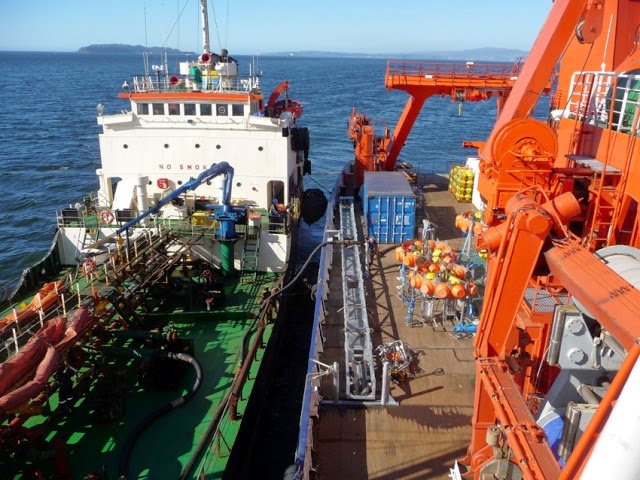
La bettolina è una piccola nave cisterna adibita al rifornimento di bunker oil.
Questa imbarcazione si accosta alla nave che deve essere rifornita e, dopo aver effettuato un sicuro ormeggio, si collega, tramite la linea di imbarco, alla flangia di imbarco della nafta.
Tramite le pompe della bettolina il bunker oil viene quindi trasferito a bordo della nave.


Rifornimento da deposito costiero


Il rifornimento di bunker oil può essere effettuato da depositi costieri.
Il bunker viene movimentato tramite tubazioni da apposite pompe (pompe del deposito) che lo trasferiscono dalle cisterne del deposito alla nave.


Stazione di imbarco


La stazione di imbarco o bunker station è la postazione di lavoro degli addetti al bunkeraggio, ogni nave ne possiede almeno una per murata (stazione di imbarco di dritta e di sinistra).
Nella stazione sono installati gli agganci per le linee di imbarco del bunker oil, della nafta leggera e dell'olio lubrificante e gli agganci per le linee di sbarco delle acque nere e delle morchie.
Ogni attacco è provvisto di rubinetto per i campioni, manometro e termometro.
La stazione può essere munita di una gru o di un paranco per issare le manichette.


Sulle navi da carico la stazione di imbarco è situata sul ponte di coperta, solitamente nella zona poppiera o a mezza nave.


Sulle navi con murate molto alte, come le navi passeggeri, le stazioni di imbarco vengono ricavate all'interno di recessi nelle murate.
In questo caso la stazione deve essere isolata dagli altri compartimenti, chiudibile con un portello stagno e protetta esternamente da una battagliola o da una catena.


Il campionamento del bunker

La convenzione internazionale per la prevenzione dell'inquinamento causato da navi o Marpol 73/78 stabilisce che i campioni di bunker oil prelevati siano quattro, tutti sigillati e firmati dall'ufficiale responsabile del bunkeraggio e dal rappresentante del fornitore.
Un campione di bunker viene conservato a bordo in caso di controlli per verificare il tenore di zolfo.
I rimanenti campioni vengono consegnati rispettivamente a:

La società venditrice del bunker oil;
La bettolina o il deposito costiero;
Un laboratorio di analisi.


Norme di sicurezza


L'international Safety Management Code impone alle società armatrici di dotarsi di un Safety Management Manual (SMM)  che tratta in maniera dettagliata le norme di sicurezza durante le operazioni di bunkeraggio.
Le norme di sicurezza generali da rispettare sono le seguenti:

Rispettare le precauzioni per la prevenzione degli incendi;
Issare la bandiera Bravo (o accendere un fanale rosso se l'operazione viene svolta di notte) per tutta la durata delle operazioni;
Ormeggiare con sicurezza la bettolina lungo la murata;
Racchiudere lo specchio di mare fra la nave e la bettolina con panne galleggianti anti-inquinamento.


Procedure e responsabilità


Il direttore di macchina, responsabile delle operazioni di bunkeraggio, si occupa del calcolo della quantità di bunker necessario per la traversata.
Il comandante si occupa della prenotazione della quantità di olio combustibile necessario.
La bettolina carica solamente la quantità di bunker prenotata, se l'approvigionamento viene effettuato da un deposito costiero il fornitore è tenuto a riempire un serbatoio con la sola quantità prenotata.
L'ufficiale responsabile del bunkeraggio è tenuto a prendere contatto con il comandante della bettolina. Dopo aver compilato uno statino delle procedure di sicurezza e aver stabilito la pressione di pompaggio, l'ufficiale responsabile autorizza il collegamento delle linee di imbarco e, una volta ultimate le operazioni di carico, effettua un'ispezione sulla bettolina o nel deposito costiero per accertarsi che le cisterne siano vuote.


Bunkeraggio LNG


Il bunkeraggio LNG (Liquefied Natural Gas) è l'operazione di rifornimento di gas naturale liquefatto a bordo di navi che lo impiegano come combustibile per la propulsione.
Con la diffusione degli apparati propulsivi a gas in ambito navale questa tipologia di bunkeraggio sta assumendo sempre maggior rilievo.


Bunkering

The bunkering is the operation of fuel supply (bunker oil) before a voyage.
The supply of bunker oil can be carried out through a coastal depot pipe or by barge.


Barge supply


The barge is a small tanker used for the supply of bunker oil.

The barge approaches the vessel to be supplied and, after the mooring, a pipe that goes from the barge to the ship is positioned. 

Through the barge pumps the bunker oil is transferred to the ship.


Coastal depot supply


The supply of bunker oil can be carried out from coastal deposits. 
The bunker is moved through pipes by pumps that transfer it from the storage tanks to the ship.


Bunker station


The bunker station is the seafarers workplace during bunkering operations, the ship has at least one on each side (starboard bunker station and port bunker station). 
In the station are installed connections for boarding lines of bunker oil, fuel oil and lube oil and connections for landing of sewage and bilge water. 
Each connection has tap for samples, pressure gauge and thermometer. 
The station can be provided with a crane or a hoist to hoist the hoses.


On cargo ships the bunker station is situated on the upper deck, usually at the stern or amidships.


On very high sides ships, such as passenger ships, bunker stations are situated inside recesses in the sides. 

On these kinds of ships, the station must be isolated from the other compartments, closed with a watertight hatch and protected externally by a rail or a chain.


The sampling of the bunker

The International Convention for the Prevention of Pollution from Ships, or MARPOL 73/78 provides that the bunker oil samples to be taken are four, all sealed and signed by the bunkering officer and the supplier. 
A bunker oil sample is kept on board in case of checks to verify the sulfur content. 
The remaining samples are delivered to: 

The bunker oil seller; 
The barge or coastal depot;
 An analysis laboratory.


Safety rules


The International Safety Management Code requires shipping companies to adopt a Safety Management Manual (SMM), which is a detailed collection of safety rules during bunkering operations. 

The general safety rules to be observed are as follows: 


Observe fire preventions precautions; 
Hoist the Bravo flag (or turn on a red light if the operation is carried out at night) during the operations; 

Safely moor the barge along the ship's side; 

Enclose the stretch of sea between the ship and the barge with floating barrier to avoid oil spills.


Procedures and responsibilities


The chief engineer, bunkering operations manager, deals with the calculation of the amount of bunker for the voyage. 
The master is responsible for the booking of the amount of needed oil.

The barge charges only the amount of bunker booked if the procurement is carried out by a coastal depot the supplier is required to fill a tank with only the booked bunker oil. 

The bunkering officer is required to contact the barge master. After compiled a form of security procedures and determined the pumping pressure, the officer authorizes the connection of the hoses and, at the end of the loading operations, he inspects the barge or the coastal depot to make sure that tanks are empty.


LNG Bunkering


The LNG bunkering is the supply of liquefied natural gas on board vessels using it as engine fuel. 
With the gas equipment spread in marine propulsion this type of bunkering is becoming more and more important.